27 September 2026 · TikTok Ban Service · 14 min read
How to report a scam or scammer on TikTok, from sponsored ads to fake TikTok texts
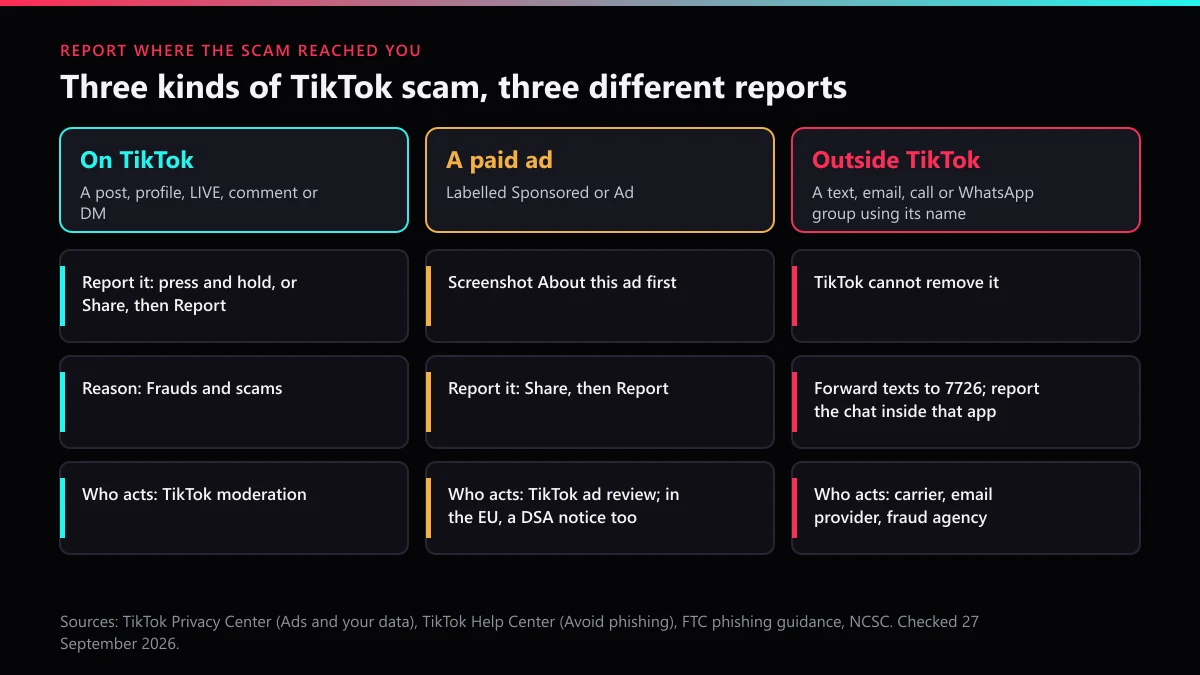
Report the scam where it reached you. For a post, profile, LIVE or DM, press and hold or tap Share, then Report, and choose Frauds and scams. For a sponsored ad, screenshot About this ad before reporting it the same way. A text, email or call using TikTok's name goes to your carrier or fraud agency instead.
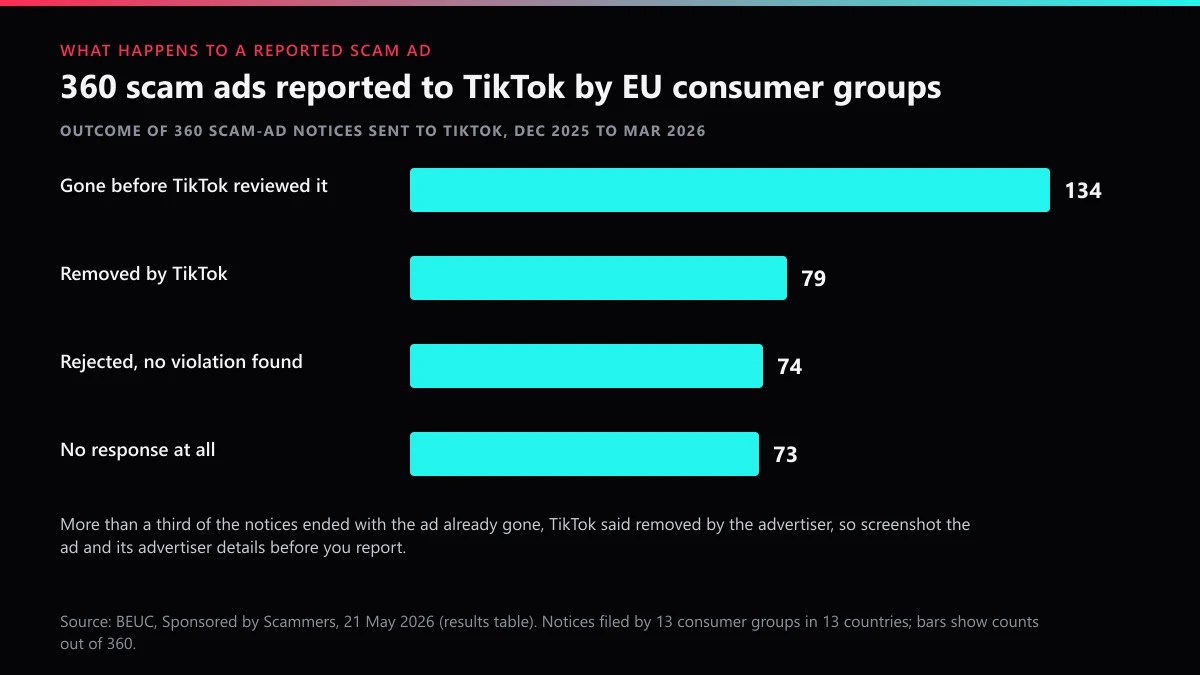
Between December 2025 and March 2026, thirteen European consumer groups did what this guide is about, on a large scale. They reported 360 financial scam ads to TikTok through its own tools. TikTok took down 79 of them. It rejected 74, never answered 73, and in 134 cases replied that the advertiser had removed the ad before anyone could review it. Those are the figures in BEUC's report Sponsored by Scammers, published on 21 May 2026 alongside complaints filed under the EU's Digital Services Act.
None of that is a reason to skip reporting. It shows which reports fail.
Most of the failures share a cause: by the time anyone looked, there was nothing left to look at. A sponsored post that vanishes takes its evidence with it. A text sitting in your SMS inbox is invisible to TikTok's moderators, and an email wearing TikTok's logo was never on TikTok in the first place. So the first decision is not which button to press, but where the scam actually reached you.
Where did the scam reach you?
In one of three places, and each has its own report: content on TikTok, a paid ad on TikTok, or a message somewhere else that borrows TikTok's name. The table sorts the common cases; find your row before deciding how to report a scam on TikTok.
| Where you met it | What it usually looks like | Report it to | Keep before you report |
|---|---|---|---|
| A video, profile, LIVE or comment | A fake giveaway, a "mentor" selling trading signals, a bio link to a deposit page | TikTok, from the Report menu on that item | Profile link, @username, screenshots |
| Direct messages on TikTok | A "manager" who wants to continue on WhatsApp or Telegram | TikTok: report the chat, then Report and block | The whole conversation, before you block |
| A sponsored ad | A famous face "endorsing" an app, fast loans, a trading platform | TikTok, from the Report option on the ad | The About this ad screen and the advertiser name |
| A TikTok Shop listing or chat | A seller asking for a deposit or a fee outside checkout | TikTok Shop, through the chat, the product and Help | Order number and the chat |
| A text or a WhatsApp group | Paid "tasks": liking or following TikTok accounts | That app's own Report; forward texts to 7726 | Sender number and screenshots |
| An email | A "copyright violation", a badge offer, a Shop refund | reportphishing@apwg.org (US), report@phishing.gov.uk (UK) | The original email, forwarded unchanged |
| A phone call or a number found in search | "TikTok support" asking for a code or a card | Hang up, then your bank if you paid | The number and the time of the call |
The first four rows fall under TikTok's own rules. For videos, comments and messages that is the Frauds and Scams section of the Community Guidelines, the part people mean when they search for TikTok frauds and scams. Paid ads answer to TikTok's Advertising Policies as well. The last three rows are not on TikTok's servers at all, which is why a report inside the app cannot remove them, however accurate it is.
How to report a scammer on TikTok when the scam is a post, a profile or a DM
Press and hold the video, or tap Share, then Report, and choose the frauds and scams reason. That is the category TikTok itself pointed users to when its Singapore newsroom warned about job scams using its name on 17 January 2024. For a profile, start from the Share button on the profile so the whole account is judged, not one clip; reporting a profile or a single video sets out both paths, and the step-by-step video report covers the web version. The separate guide on reporting the account so it goes down goes through the ban grounds a scam profile falls under.
Two details save time. If the scam comments sit under your own videos, TikTok lets you select up to 100 of them and report the comments in one batch, so there is no call for the spam report bots some sellers advertise. And if you have no TikTok account, the web report forms accept a profile link without a login.
How do I report a scammer on TikTok who is targeting a parent or grandparent? You report what you can see, from your own phone. Anyone can report a public video or profile. Messages are different: only the person in the chat can report it, so sit with them and do it on their phone, then call their bank together. If you are working out how to report fraud on TikTok on someone's behalf, keep the order the same: money first, report second.
How do you report a scam ad on TikTok before it disappears?
Capture the advertiser details first, then report. TikTok marks every paid placement with a "Sponsored" or "Ad" label and, according to its Privacy Center page on ads and your data, lets you report an ad from the same menus you use for any video. The same page describes an About the advertiser panel showing the advertiser's name, whoever paid for the ad if that is someone else, and the country where the advertiser registered with TikTok. That panel is your evidence once the ad is gone.
- Screenshot the ad as it appears in your feed, including the caption and the button text.
- Tap the Share icon at the bottom right of the ad, or press and hold the video, and open About this ad. Screenshot the About the advertiser section.
- Go back to the same menu and choose Report, then follow the on-screen steps.
- Where the form asks for detail, write one tight sentence: what the ad claims, who it impersonates and what it asks for. Consumer groups found a 200-character limit on that box.
- Do not tap through to the website. In Europe, the ad library is meant to keep the link for you.
Scrolled past it? TikTok's Help Center describes a Share feedback page for ads at Settings and privacy, then Ads, then Share feedback, called Your ad activity in some regions, where you can review ads you engaged with. In the EEA, Switzerland and the UK there is a second route: the Commercial Content Library at library.tiktok.com, which needs no account. TikTok's Help Center article on the library says ads usually appear there within 24 hours and stay for a year after their last view, with the advertiser, the payer, first and last shown dates and a reach estimate. Under commitments the European Commission accepted on 5 December 2025, TikTok agreed to show each ad's full content, including the URLs it links to.
Deepfakes have their own rule. TikTok's advertising policy on misleading and false content, updated in April 2026, bars ads that misuse "the likeness (audio or visual) of a public figure without their permission", and says AI-generated ads that are not disclosed will be rejected or restricted. A celebrity who never endorsed the trading app on screen is therefore a policy breach you can name in the report text, in plain words, rather than a matter of taste. For ads that break the law in an EU country, a legal takedown notice through TikTok's illegal-content route is the stronger filing.
Why did 360 scam-ad reports get such mixed results?
Because TikTok rarely had to argue: in 134 of the 360 cases, it said the ad was already gone. BEUC puts TikTok's removal rate at 21% of submitted ads and the gone-before-review share at 37%, for scam ads that, across the three platforms it tested, reach more than 200 million people in Europe every month. The report describes the rest. When its members reported ads, TikTok did not confirm receipt. Rejections came without reasons, usually on the ground of insufficient evidence, although the ads were plainly fraudulent. Two ads carrying the same message were reported with the same legal argument; one came down and the other stayed. Some ads were removed only in the "affected regions", Belgium, Hungary and Norway in one example, while staying live elsewhere in Europe. Trusted flaggers had a better time: TikTok acknowledged their notices and usually told them its decision.
Three lessons follow for anyone who wants to report a TikTok scam ad. Evidence has to exist outside the app, which is the whole point of the screenshots. The 200 characters should carry the one checkable fact a reviewer can confirm in seconds, such as a named person who never endorsed the product. And a rejection is not the end. In the EU, a notice sent through the illegal-content route is owed a decision under the Digital Services Act, and BEUC's complaint argues that a rejection given without reasons falls short of it.
Is that WhatsApp job or text message really from TikTok?
No. Offers to pay you for liking, following or commenting on TikTok videos come from scammers using the company's name, and TikTok's January 2024 warning described exactly that pattern, group chats and unsolicited messages offering money for social media tasks, before stating that "TikTok and its partners do not operate in this manner". In Singapore alone, police counted at least 180 victims and at least S$2.6 million lost to that scheme in December 2023, according to a police advisory of 8 January 2024; some of the scammers claimed to represent TikTok and sent victims to a fake TikTok website. Which? found the same script on Telegram in August 2025: a "task" of liking specific TikTok posts, paying "90 - 300 euros or more per day".
TikTok cannot remove any of it, because none of it happens on TikTok. Report the chat inside WhatsApp or Telegram, forward the first text to 7726, and leave the group. The exception is a hybrid scam. In May 2026, Graphika traced fake World Cup ticket sites promoted from the bios of two TikTok profiles, with the sites sending buyers on to WhatsApp numbers. There the TikTok profile is reportable, and so is the number.
A scammer who turns abusive when you stop replying has moved into a different policy. Threats and repeated contact belong in a harassment report, and anything involving intimate images or threats to your safety is urgent enough for the police and for urgent removals at the same time.
TikTok scammer report email or number: which ones are genuine?
Neither exists for scam reports. TikTok takes a tiktok scammer report online, in the app or through its web forms, and a website printing a "TikTok fraud line" is more likely to be running a scam than stopping one. What TikTok does send is narrow. Its For Business help page says genuine emails come from addresses ending in tiktok.com or bytedance.com, and that "TikTok will never ask for your account password or multifactor code". Its Help Center page on phishing lists only two direct contacts: an in-app notice with a pop-up you accept, for problems such as a Coins recharge, and @tiktok.com email about verified badges for government and political accounts.
TikTok's Malaysia newsroom went further on 27 August 2025: TikTok and TikTok Shop "will never request users' sensitive personal information" by text, call or email. It also warned about lookalike spellings such as "t1k-t0k", and pointed users to Profile, Menu, Settings and privacy, Report a problem. That is the in-app place to tell TikTok its name is being abused.
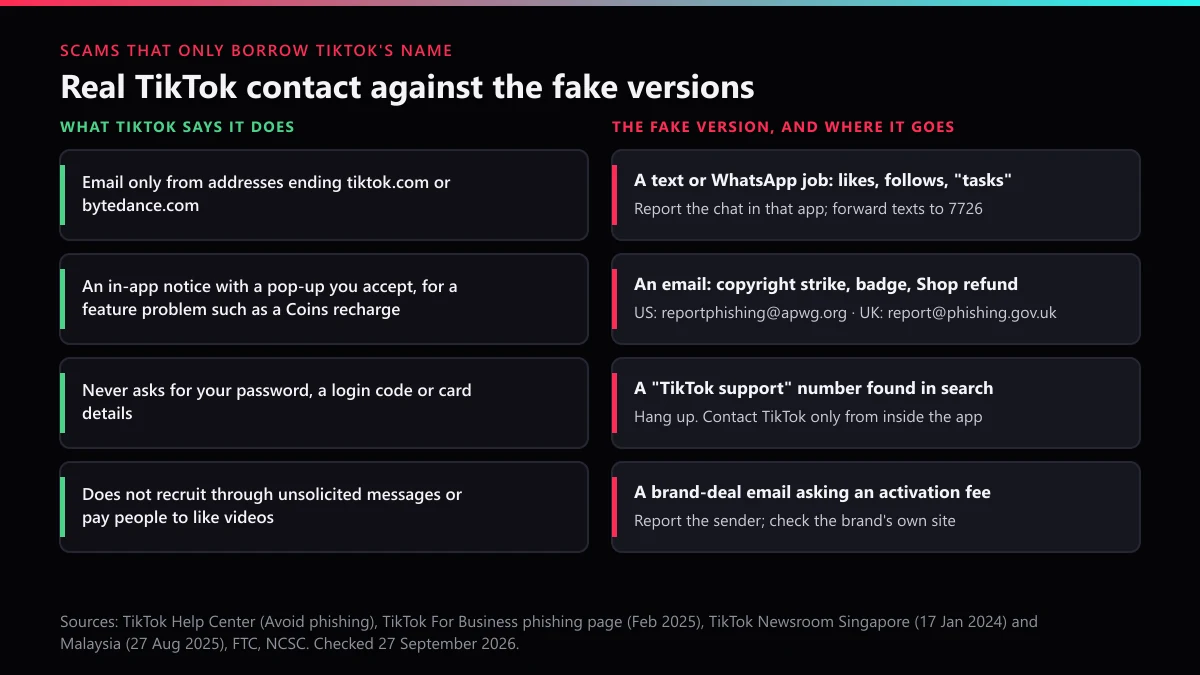
The fake email itself goes elsewhere. In the United States, the FTC's phishing guidance says to forward emails to reportphishing@apwg.org, forward texts to SPAM (7726) and report at ReportFraud.ftc.gov. In the UK, the NCSC's reporting service at report@phishing.gov.uk had logged more than 58 million reported scams by July 2026, leading to 256,000 scams removed across 454,800 URLs, according to the NCSC's own counter. Phone numbers are the other trap. The FTC warned on 3 April 2025 that scammers "might even put their number alongside a trusted company's name" in search results, which is exactly where people typing a TikTok scammer report number end up.
Creators get their own versions: brand deals, badges and fake strikes
Creators with an email address in their bio are a target list. Graphika documented a fake SKIMS partner programme on 21 May 2026: creators who applied were told to pay $60 to $80 in "activation" fees, through three lookalike domains registered between February and April 2026. Any brand deal that starts with you paying is a scam, whatever logo it wears. Report the email as phishing, then check the brand's own website for its real creator programme.
The other creator scam is theft. Scam ads and fake giveaway accounts often run on someone else's face and footage, and the person filmed has routes a bystander lacks: reporting stolen videos as copyright, and reporting impersonation of a creator or brand. When the copycat also holds a handle that should be yours, reclaiming a username a fake account holds is a separate request. Fake "TikTok Support" and "Creator Team" profiles fall under TikTok's rules on fake accounts, and Shop sellers who take payment and vanish are covered in removing a TikTok Shop seller.
What TikTok Ban Service checks before filing a scam report
Where the scam lives, what proof survives, and which rule it breaks. TikTok Ban Service starts with the first question because it decides everything else: a message on WhatsApp gets a referral, not a TikTok filing. When we worked through TikTok's ad tools for this guide on 27 September 2026, the ad library's Ad target country box came up already set to the country we were connecting from, not the country where the ad had run. Anyone checking a UK ad from abroad has to change that box first, or the search looks at the wrong market. We now ask people who send us an ad which country they saw it in, together with the About the advertiser screenshot and the date.
We also say no. We do not report a seller for being slow, or a competitor for being a competitor, and we do not sell volume. The mass-report bots and account report bots sold on Telegram send the same report many times over, and what these tools actually do shows why a reviewer who has already decided an item reaches the same verdict on the fiftieth copy. Report counts do not decide bans, nobody outside TikTok can delete an account, and paying someone to remove an account buys nothing TikTok recognises. What does work is the ground TikTok bans on, set out in what actually gets an account banned, filed under the right violation category, and escalated to a full account takedown when the whole profile exists to defraud. TikTok Ban Service files and escalates the report; TikTok makes the decision, and it can decline to act.
If a phishing email got into your own account, secure it before anything else: change the password, turn on 2-step verification and check the devices logged in. Deleting your own account is a last resort, not a fix.
Screenshot the ad and its advertiser panel today, then report it from the ad. Report scam posts and chats from inside TikTok, and send fake TikTok texts and emails to 7726, the APWG or the NCSC rather than to TikTok. If a scam account or ad is still live after that and the proof is on your screen, send us the ad details and we will tell you which route fits before anything is filed. The full list of violations we handle covers the rest.
FAQ
Can I still report a TikTok scam ad after it has left my feed?
Often, yes. Open Settings and privacy, then Ads, then Share feedback, called Your ad activity in some regions, to find ads you engaged with. In the EEA, Switzerland and the UK, the Commercial Content Library at library.tiktok.com lists ads for a year after their last view, without a login.
Does TikTok scam reporting come with an answer?
Not reliably. EU consumer groups that reported 360 scam ads between December 2025 and March 2026 got no receipt and, often, no answer. Reports sent through TikTok's EEA route for illegal content are different: TikTok says those reporters are notified of its decision, including when it finds the content legal.
A WhatsApp group is paying people to like TikTok videos. Is TikTok behind it?
No: TikTok said in January 2024 that it and its partners do not operate that way, and small early payouts followed by a deposit to "unlock" bigger tasks is the standard task-scam script. Report the group inside WhatsApp, leave it, and never send the deposit.
An email says my TikTok will be removed for copyright. Is it real?
Check the sender first. TikTok's For Business help says genuine emails come from addresses ending in tiktok.com or bytedance.com, and TikTok says it never asks for a password or login code. Real violation notices arrive in the app's inbox. Forward a fake one to reportphishing@apwg.org in the US or report@phishing.gov.uk in the UK.
A scam ad is using my face or my videos. What should I file?
File as the person in the video, because that gives you routes a bystander lacks. A copyright report covers footage you own, and an impersonation report covers an account or ad pretending to be you. Report the ad itself as well, stating in the short text box that you are the person shown and never agreed to it.
TikTok rejected my report of a scam ad. Can I do anything else?
Yes. Report what the rejected notice lacked: the advertiser named in About this ad, the landing page from the ad library, and the specific rule broken, such as an undisclosed deepfake. In an EU country, file under TikTok's illegal-content route and name the country, which also gives you a decision you can challenge.